Why One Page Gets Cited by AI and Its Near Identical Twin Gets Ignored
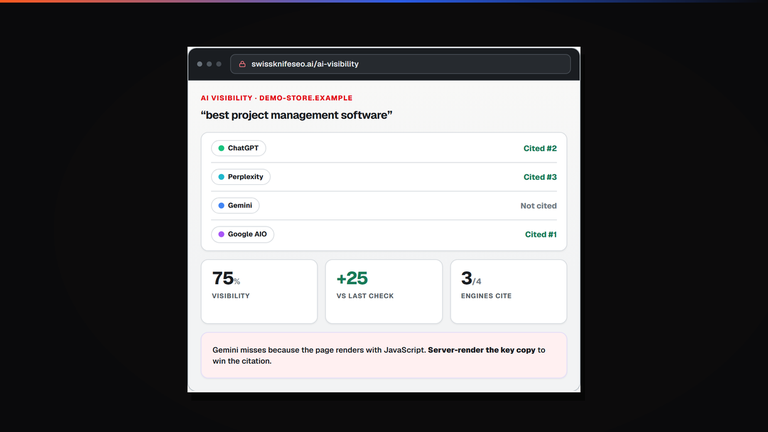
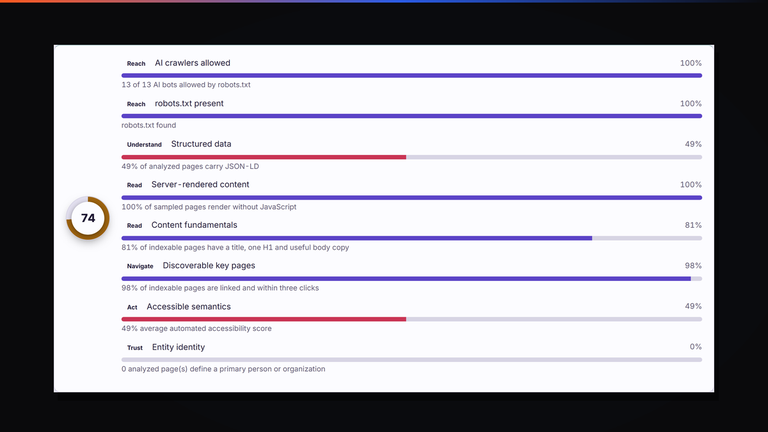
Two pages, same template, same quality, and only one of them ever gets named as a source. The eight weighted signals behind an AI readiness score...
Read the guide ›
Most startups operate with tight budgets, limited teams, and no patience for tactics that take a year to show results. That makes SEO both the most logical and the most misunderstood channel to invest in early. It's logical because organic search is the only marketing channel that compounds: the content you publish and the authority you build this quarter continue paying dividends two years from now. It's misunderstood because most startup SEO advice is either too generic to act on or too tactical to fit into a coherent strategy.
This guide lays out a complete, sequenced approach to SEO for startups: where to start, what to prioritize at each stage, and how to build a foundation that scales as your company grows. If you're new to the discipline, the overview of what search engine optimization actually is covers the foundational concepts worth understanding before building a strategy around them.
Paid acquisition has an obvious appeal for startups: you can turn it on, see results immediately, and measure ROI with relative precision. The problem is that paid acquisition is a faucet, not a reservoir. Stop paying, and the flow stops completely. For a startup that needs to extend runway and build defensible customer acquisition channels, that dependency is a structural risk.
SEO builds a reservoir. A page that ranks for a high-intent search term continues generating qualified visitors without incremental cost per click. The economics improve the longer you invest. For most startups, the ROI of SEO relative to paid channels becomes favorable somewhere between months 12 and 24, and it only widens after that as your domain authority grows and older content continues compounding.
There are timing realities to be honest about. New domains with no backlinks and thin content don't rank for competitive keywords overnight. A realistic startup SEO timeline is three to six months to see early traction on lower-competition keywords, and 12 to 24 months to build meaningful organic traffic on more competitive terms. Starting early, even with limited resources, is therefore more important than starting perfectly.
Keyword research for a startup is fundamentally different from keyword research for an established domain. A site with strong domain authority can go after high-volume, competitive keywords. A new site trying to rank for those same terms will spend months producing content that sits on page three of search results, generating no traffic and building no momentum.
The right approach early on is to target what are called long-tail keywords: more specific, lower-volume search queries that have significantly less competition. These are the searches where the user's intent is clearer and the barrier to ranking is lower. The aggregate traffic from ranking for dozens of long-tail terms often exceeds the traffic you'd theoretically get from one high-volume term, while being far more achievable for a new domain.
Understanding search intent is inseparable from keyword selection. For every keyword you're considering targeting, ask: what does someone who types this actually want? Are they looking for information, for a product to buy, for a comparison, or for a specific website? Your content needs to match that intent precisely. A product page targeting an informational query won't rank, regardless of how well-optimized it is technically.
A practical keyword research process for early-stage startups involves three steps. First, identify the core topics that describe what your product or service does and the problems it solves. Second, expand each core topic into a cluster of related keywords using tools like Ahrefs, Semrush, or Google's free Keyword Planner. Third, filter that expanded list by keyword difficulty, prioritizing terms where the top-ranking pages come from sites with modest domain authority rather than major publications or established category leaders.
Keyword clustering matters as much as keyword selection. Rather than creating one page per keyword, group related keywords by topic and intent and create one comprehensive page for each cluster. This approach concentrates your authority on fewer, stronger pages rather than diluting it across dozens of thin pages that cover the same territory from slightly different angles.
Before you invest heavily in content production or link building, make sure your site's technical foundation doesn't have problems that will undermine everything else. Technical SEO issues act as a ceiling: you can produce excellent content and earn strong backlinks, but if crawlers can't access your pages efficiently or if your pages load too slowly for real users, those investments underperform their potential.
Your hosting environment is the starting point. Slow server response times, overcrowded shared hosting environments, and geographic distance between your server and your primary audience all affect page load speed directly. Choosing the right hosting provider from the beginning is far easier than migrating after your content library grows. The cost difference between mediocre and good hosting is often minimal relative to what slow load times cost in rankings and conversions.
Mobile-first indexing means Google uses the mobile version of your site for ranking purposes, regardless of which device most of your visitors use. Every page needs to render correctly, load quickly, and be navigable on mobile devices. Google Search Console's Mobile Usability report shows issues across your entire site automatically, which makes it easy to identify and prioritize fixes.
HTTPS is non-negotiable. A site still running on HTTP faces both a minor ranking disadvantage and the active deterrent of browser security warnings that display to visitors before they can access your pages. Install an SSL certificate if you haven't already and ensure your entire site redirects to the HTTPS version with no mixed-content errors.
Site architecture and internal linking affect how crawlers discover and index your content and how page authority flows through your site. A flat, logical structure where every page is reachable within two or three clicks from the homepage is far more crawl-friendly than a deep hierarchy where important pages are buried five levels down and connected to nothing. Every new page you publish should receive at least two or three contextual links from relevant existing pages.
Your choice of website platform shapes your technical options significantly. The comparison of Wix, WordPress, and Squarespace covers how each platform handles technical SEO fundamentals. WordPress provides the most granular control through plugins like Yoast or Rank Math, which handle sitemap generation, schema markup, title tag optimization, and a range of other technical elements automatically. Adding schema markup to your pages early in your site's life sets a strong technical standard that becomes increasingly valuable as your content library grows and you become eligible for rich result placements in search.
Submit an XML sitemap through Google Search Console once your site is set up and your initial content is live. This tells Google which pages to crawl and index and allows you to monitor indexing status and crawl errors as they appear. Check Search Console weekly in the early months of a new site's life.
Content is where most startup SEO strategies succeed or fail. It's also where most startups make the same predictable mistakes: publishing thin, generic blog posts that don't differentiate from what already ranks, producing content faster than it can be done well, or writing for keywords rather than for the people searching them.
Google's ranking algorithms have become increasingly effective at measuring actual content quality, not as a proxy of content length or keyword density, but as a function of how thoroughly and accurately a page answers the query it targets. A 1,500-word article that directly answers the question someone searched, uses specific examples, goes beyond the surface of the topic, and covers the follow-up questions a reader is likely to have will consistently outrank a 3,000-word article that pads its word count with repetition and filler.
For each piece of content, start by looking at the top five to ten results currently ranking for your target keyword. What do they cover well? What are they missing? What depth are they going to? Your content needs to match the depth and breadth of what's already ranking at minimum, and ideally exceed it in the areas where existing results are weakest. This is called the skyscraper approach, and while the name is overused, the underlying logic is sound: you need to be better than what's already there, not just present.
Content types that consistently earn featured snippets and strong rankings include: comprehensive guides that cover a topic end-to-end, comparison articles that help readers make decisions between alternatives, how-to articles that walk through specific processes step by step, and data-driven content that cites real statistics and research. Each of these formats signals to Google that the content is substantive and organized, which are the characteristics that earn both rankings and featured snippet placements.
Publish at a pace that maintains quality rather than at a pace that maximizes volume. Three excellent articles per month consistently outperform ten thin ones over a 12-month horizon: the excellent articles earn backlinks, retain readers, and rank for additional related terms, while the thin ones rarely rank for anything and waste the crawl budget Google allocates to your site.
Content refresh is as important as new content production. Older articles that were once ranking but have slipped often need updating rather than replacement: new data, additional sections covering recent developments, restructured headings, and additional internal links to newer content on related topics. A quarterly audit of your top-performing and recently declining content should be part of any startup's SEO workflow from year one.
Domain authority is accumulated, not purchased. For a new startup with no backlink profile, this is the most time-consuming part of SEO and the one that requires the most patience. There are no shortcuts that hold up to Google's scrutiny long-term.
The most sustainable path to building backlinks is producing content others genuinely want to reference. Original research based on your own data, proprietary surveys of your customer base, detailed comparison studies, and free tools or templates all attract links from other sites organically. The guide on creating link-worthy content covers what makes content earn links versus what makes it competent but invisible, and the difference is significant.
Guest posting on relevant publications is the most controllable form of link building for early-stage startups. By writing for established publications in your niche, you earn editorial backlinks while simultaneously getting your name in front of audiences you don't yet have. The complete guide to guest posting covers the full process: how to identify the right publications, craft pitches that get accepted, and write articles that editors want to publish again.
Digital PR, while more resource-intensive than guest posting, produces the highest-authority links available. Getting your startup mentioned in major publications, quoted in industry roundups, or featured in relevant news coverage generates links from sites with domain authority scores that content marketing alone rarely reaches. Tools like HARO (Help a Reporter Out) connect startups with journalists actively looking for sources, which is a low-cost entry point into PR-driven link building.
For the all types of SEO that involve external authority, one principle holds consistently: quality of links matters far more than volume. Five editorial links from respected industry sites will do more for your domain authority than 100 links from irrelevant or low-quality sources, and the latter carries risk that the former doesn't.
If your startup serves customers in a specific city, region, or service area, local SEO isn't optional: it's where your most qualified traffic comes from. People searching for a product or service "near me" or in a specific location have immediate, high-intent needs. Appearing prominently for those searches produces customers, not just visitors.
The Google Business Profile is the most important local SEO asset and requires proper setup and ongoing management. An optimized profile with accurate contact information, complete service listings, high-quality photos, a compelling description, and a consistent stream of recent reviews consistently outperforms a sparse or incomplete profile in local search results and map placements.
NAP consistency (Name, Address, Phone number) across all online directories matters because Google cross-references this information to verify that your business is legitimate. Inconsistencies reduce Google's confidence and suppress local rankings. A citation audit in your first six months of operation is worth running even for very early-stage businesses, because incorrect information accumulates across directories quickly and becomes harder to clean up later.
The full depth of local SEO strategy, including how to optimize your Google Business Profile, how to build location-specific landing pages, and how to earn local backlinks, is covered in the dedicated guide on local SEO for businesses.
One of the most common startup SEO mistakes is tracking vanity metrics: raw page views, total traffic, or social shares, while missing the metrics that actually indicate whether your SEO strategy is working. A clear measurement framework makes the difference between an SEO program that iterates intelligently and one that produces effort without direction.
Organic traffic from Google Search Console is the most direct measure of SEO performance. More specifically, track organic clicks (actual visits), impressions (how often your pages appear in search results), average position for your target keywords, and click-through rate (the percentage of impressions that result in a click). Each of these tells you something different: rising impressions with flat clicks suggests a CTR problem (likely a title or meta description issue); rising average position with flat traffic suggests you're close to breakthrough rankings for terms that generate significant traffic volume.
Keyword ranking tracking gives you a leading indicator of future traffic trends. Tools like Ahrefs, Semrush, or Mangools let you monitor your rankings for a defined list of target keywords over time. Track not just your primary keywords but also the long-tail clusters you're targeting early in your strategy, since these are where new sites build initial traction before moving to more competitive terms.
Backlink profile growth is the key off-page metric. Track the number of referring domains (unique sites linking to you, which matters more than total link count) and the authority distribution of those domains using Ahrefs or Moz. A steadily growing referring domain count from relevant, reputable sites indicates that your content and outreach efforts are building the authority base your rankings depend on.
Conversion attribution is the bridge between SEO performance and business outcomes. Google Analytics lets you set up goal tracking for the actions that matter to your startup: form submissions, demo requests, email signups, or purchases. Attributing these conversions to organic search confirms which content is generating not just traffic but actual business value, which informs where to invest your content and optimization effort going forward.
The most expensive startup SEO mistake is targeting competitive keywords before your domain has the authority to rank for them. Months of content production for terms your site can't realistically rank for is wasted effort that produces neither traffic nor learning. Match your keyword targets to your current domain authority level and advance to more competitive terms as your authority grows.
Neglecting technical SEO in favor of content production is a close second. Content that can't be crawled efficiently, that loads slowly on mobile, or that has duplicate content issues generating competing internal pages won't rank as well as it should regardless of its quality. Get the technical foundation right first and revisit it every quarter as your site grows.
Treating SEO as a launch-and-forget project rather than an ongoing practice produces a pattern of short-term traction followed by stagnation. Google's algorithms reward consistency: regularly published, high-quality content; a growing backlink profile; and an improving technical health score all signal an actively maintained site, which compounds in rankings over time.
Producing content for too many topics simultaneously rather than building topical depth in focused areas is another common mistake. A site that has five articles on SEO, five on social media, five on paid ads, and five on email marketing will consistently rank below a site that has 30 deeply interconnected articles on SEO alone, because the latter has built topical authority in a way the former hasn't.
If you're building this capability in-house rather than with outside help, reviewing what skills an SEO specialist actually needs gives you a practical benchmark for the competencies involved across technical, content, and off-page disciplines. Understanding what the role entails helps you evaluate whether your team has the necessary expertise or where you might have gaps that need filling.
Setting accurate expectations matters as much as building the right strategy. Unrealistic timelines lead to abandoning SEO before results materialize, which is the most common reason startup SEO programs fail.
Months 1 to 3 are the foundation phase. Set up your technical infrastructure, conduct keyword research, publish your first 10 to 15 pieces of content, and submit your sitemap to Google Search Console. You'll see minimal organic traffic during this phase, but you should start seeing your pages get indexed and your first long-tail keywords appearing in Search Console impressions data.
Months 4 to 6 are the early traction phase. Pages published in months 1 to 3 start to appear in search results, typically in positions 15 to 30 for your less competitive targets. Some of your long-tail targets will reach the first page. Organic traffic will be modest but measurable. Continue publishing at a consistent pace and begin proactive guest posting and link building.
Months 7 to 12 are the momentum phase. With a growing backlink profile and a more substantial content library, you'll start seeing rankings improve meaningfully for your primary targets. Pages that reached positions 15 to 30 in months 4 to 6 often move to the first page. Organic traffic should be growing month over month. This is when the compounding effect starts to become tangible.
Year 2 and beyond is where startup SEO pays dividends. Sites that maintained a consistent strategy through year one see accelerating results in year two, as domain authority compounds and the content published earlier continues attracting links and traffic. The gap between your organic performance and competitors who didn't invest in SEO early becomes increasingly difficult for them to close.
You don't need an enterprise tool stack to run effective startup SEO. A focused set of free and low-cost tools covers the majority of what you need in the first 12 months.
Google Search Console is free and indispensable. It shows you which queries your pages are appearing for, what positions they're ranking in, which pages are indexed, and whether there are technical errors affecting your coverage. No paid tool replaces it for understanding how Google specifically sees your site.
Google Analytics (or GA4) tracks traffic sources, user behavior on your site, and goal conversions. Connecting your Analytics and Search Console accounts gives you a combined view of organic search performance alongside on-site engagement metrics.
Ahrefs and Semrush are the most complete paid tools for keyword research, competitor analysis, backlink profile monitoring, and site auditing. Both have trial options and lower-tier plans suitable for early-stage startups. If budget is constrained, Ahrefs Webmaster Tools offers a meaningful subset of their functionality for free, specifically for your own site.
Screaming Frog is a desktop-based site crawler that audits your site for technical SEO issues: broken links, duplicate content, missing meta tags, redirect chains, and dozens of other technical factors. The free version handles sites up to 500 URLs, which is sufficient for most early-stage startups. Running a Screaming Frog audit quarterly keeps your technical health in check as your content library grows.
Yoast SEO or Rank Math (for WordPress) handle a range of on-page technical tasks automatically: XML sitemap generation, canonical tag management, title and meta description optimization interfaces, and basic schema markup. Either plugin is a significant time-saver for WordPress sites and removes the need to manage these elements manually through code.
Notion, Airtable, or a simple Google Sheet for editorial planning rounds out a functional startup SEO toolkit. Tracking your target keywords, content calendar, backlink outreach, and performance metrics in one place keeps the program organized and makes it easier to report on progress to investors or stakeholders who want to see evidence that the channel is building.
Many startups try to run SEO entirely in-house initially, which can work well if at least one team member has genuine experience with the discipline across technical, content, and off-page dimensions. The challenge is that SEO spans multiple distinct skill sets that rarely overlap completely in a single person. A founder with strong content instincts may still need a technical SEO consultant to audit site infrastructure. A developer who understands crawlability may not have the content strategy experience to build an effective keyword cluster plan.
The most common pattern that works for early-stage startups is a combination: a fractional SEO consultant or agency for strategy and technical auditing, paired with in-house content production. This keeps costs manageable while ensuring the strategic and technical foundation is set up correctly from the beginning. Understanding what a skilled SEO specialist brings to a team helps you evaluate whether candidates for an in-house or consultant role have the full range of capabilities the role requires, rather than deep knowledge in one area and gaps in others.
The signal that you're ready to invest more heavily in SEO help is usually when organic search has started producing measurable results but you've hit a ceiling: rankings plateau, traffic growth slows, and it's not immediately obvious why. At that point, an experienced SEO practitioner can identify the specific bottlenecks (often technical issues, a thin backlink profile, or keyword targeting that's too competitive for your current authority level) and prioritize a path forward with more precision than in-house experimentation can achieve on its own.
Run a free scan in Swiss Knife SEO, the platform we built and use on every client engagement. No account needed for the first audit.
Two pages, same template, same quality, and only one of them ever gets named as a source. The eight weighted signals behind an AI readiness score...
Read the guide ›A walk through the first scan on swissknifeseo.ai: what the crawler reports, how issues get ranked by cost rather than count, and where the AI citation...
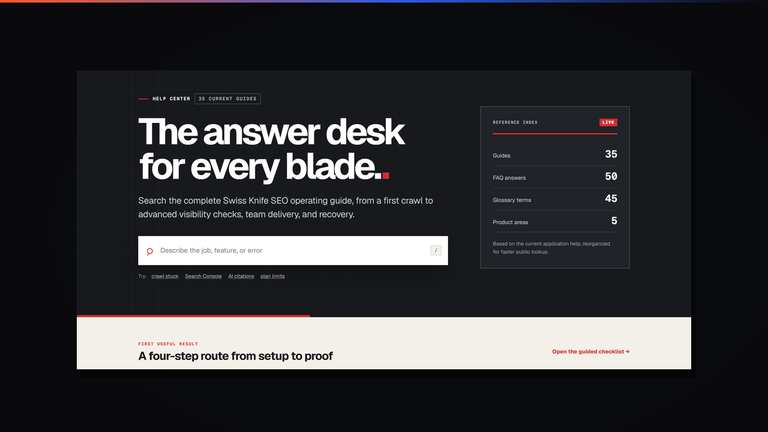
Read the guide ›The help center is a public reference, not a ticket queue. It carries 35 guides, 50 FAQ answers and 45 glossary terms, and you can read...
Read the guide ›